Joe Overstreet: Taking Flight
- allisonvyoung
- Jun 6, 2025
- 5 min read
The Menil Collection, January 24 - July 13, 2025
The boldly-colored and dynamically-shaped Justice, Faith, Hope, and Peace (1968) beacons visitors with hypnotic allure. Two rectangular canvases bracket two hexagonal configurations, with each featuring sharp angles and organic circles of pigment. Each canvas is unique, yet Joe Overstreet's (1933-2019) use of bilateral symmetry creates a hum of unity. The title evokes the foundations of the Civil Rights Movement and the activism of Martin Luther King, Jr., whose assassination promoted the artist's work on this piece. The painting serves as an appetizer and point of reference for the first major museum exhibition of Joe Overstreet's work in thirty years.

This monumental hiatus break was organized by the Menil's Associate Curator of Modern Art, Natalie Dupêcher, and the artist's estate. Three critical material and theoretical expressions from Overstreet's oeuvre are divided across five rooms in the gallery space: stretched canvases, "flight patterns," and the Senegal paintings.
The stretched canvases from the 1960s are found in the first room.These are the earliest works in the show and are aesthetically and formally linked to Justice, Faith, Hope, and Peace on display outside of the exhibition hall. These polygonal configurations defy the traditional rectilinear format of paintings and act as extensions—rather than boundaries—for Overstreet's geometric designs. Some pieces contain a certain animation or anthropomorphism in their composition, such as Untitled (1967), with more fluid lines, shapes, and brushstrokes. Others employ a mathematical approach to abstraction like Tribal Chieftain (1969). Titles of works reference crucial moments or figures in national and/or cultural contexts. Untitled (Sun Ra Series) (1967) recalls the famous Afrofuturist composer, Sun Ra. The name and visuals for North Star (1968) evokes the celestial guide for African Americans in their journey of self-emancipation. Such references further link the works and the artist to the radical national era of Black liberation and the Civil Rights Movement.
The next rooms are connected by a floor-to-ceiling pathway, and visitors are drawn by the benches and centering of a large-scale painting on the furthest wall into a clockwise—and chronological—direction. Entry into the second room presents the first displays of Overstreet's unstretched canvas works, or "flight patterns." Polygonal canvases previously confined by framing are now loose, suspended with ropes at varying heights. Their shapes, colors, and lines create an interplay between two- and three-dimensionality in geometry. The hangs of the works relax or pull the fabric: a simultaneous freedom in defying space and gravity and restrain in being anchored and tethered. Two pairs of flight patterns occupy the walls, including Man and Woman Came from a Reed (1971) and Free Directions (1971) owned by The Menil Collection. They hover along the walls at varying heights, floating throughout the space.
In the adjacent third room, the monumental Evolution (1970) draws the path of visitors with its own gravity. Perpendicular to Evolution is Hoodoo Mandala (1970) and Mandala (1970). These works are hybrids between the stretched canvases and flight patterns, drawing on the concepts of each previously mentioned. There is also a sense of cultural retention, or revisitation, on display with these works. The Civil Rights and Black Arts Movements bore witness to the reclamation of African culture(s) and the cultural genealogies found in the diaspora. The installation of these 1970 works appear as the stretching of hides and skins, an indigenous practice found across the globe. The titular "Hoodoo" references the African American diasporic ethnoreligion which combines Christianity with African ancestral worship traditions. Each of these works evokes a connection to an ancestral and religious past and how the revisitation of cultural heritage can aid in our own evolutions moving forward. We Came from There to Get Here (1970) is the only flight pattern in this room, and it appears to lift off of the small white circular platform it is tethered to. Its installation and title allude to the trafficking of Black bodies through the transatlanctic slave trade. This reference to the initial and violent physical untethering to ancestral homelands accentuates the reclamations of identity and heritage in the other works.
Overstreet’s flight patterns react to a time in national and international social politics the artist remarked as being “[t]he world…tugging with this stretch-pull system.”[1] The exhibition of these reactive designs resonate with the tension of the contemporaneous political climate. The adjacent fourth room is perhaps the most evocative space in this show. Untitled (1970) is positioned in the center of the room attached to a large white circular base. The multiple colors of the fabric are much more organic in their application, appearing to bleed into each other. Five other flight patterns hover along the walls of the room with a certain weightedness as they orbit Untitled. Each of these works is radically different from the other in terms of color and form. This variety is further emphasized in the installation of the works, which also compares to the dynamism of freedom and restraint generated in each. The animation and certain organic aspects of these works recalls those seen in the artist's stretched canvases. The comparison of objects throughout the different rooms is not just a testament to the artist's production but to the curation of the show.
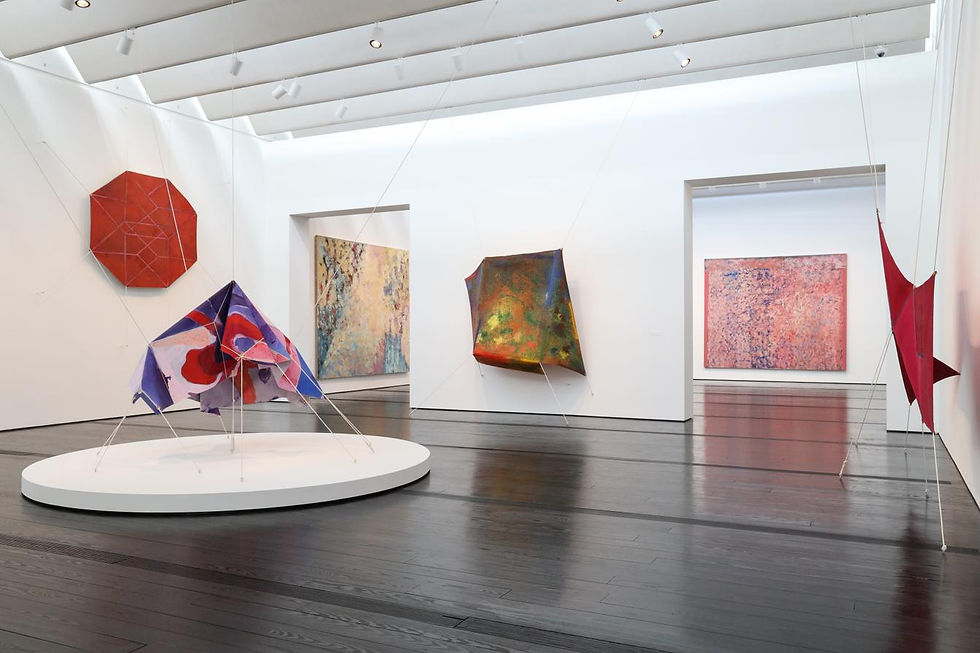
The final room—in its works and curation—differ from its predecessors. On display are the Senegal paintings, a series of monumental abstract works painted in 1993 following the artist's visit to the country the year prior. While there, Overstreet also visited Gorée Island, which operated as a massive slave-trafficking port for over three centuries and where enslaved peoples would pass through the "Door of No Return" before being boarded on slave ships.[2] Two smaller doorways act as the entrance into this final space in the gallery and—whether intentional or not—resonate with this infamous passageway. The works are atmospheric washes of color with no discernible forms, aside from the Fibonacci spiral in Cross Currents (1993) which aligns with the persistent presence of geometry in Overstreet's works. The titles here reference again the transatlantic passage of enslaved Africans, with Cross Currents and Gorée (1993). The return to a traditional format of painting differs from the radical experimentation initiated in the first room of the exhibition. However, this chronological pathway of the show parallels the near-cyclical nature of the artist recrossing the transatlantic boundary which influenced these works.
Joe Overstreet: Taking Flight is an dynamic exhibition which reverberates the dichotomies found in these abstract works. The variation of installation methods for the three distinctive career movements support the overarching narrative of tension and liberation presented in Overstreet's oeuvre. The exhibition not only reasserts the artist's contributions to and placement in modern art history, but rejuvenates the public's interest in his work with resounding vigor.
[1] Joe Overstreet: Taking Flight. Houston: The Menil Collection, 2025. Exhibition brochure.
[2] Ibid.
Comments